GLOBAL HEAVY METAL HISTORY TAKING ROOTS IN LLEIDA’S CULTURAL SPACE (Núria Bailon, Anna Mateo and Ainara Reguant)
SEEK ‘EM ALL: GLOBAL HEAVY METAL HISTORY TAKING ROOTS IN LLEIDA’S CULTURAL SPACE
By Núria Bailon, Anna Mateo and Ainara
1. Introduction
The linguistic landscape (LL) analysed (see figure 1) in this blog entry is a commercial poster advertising a tribute concert called ‘SEEK'EM ALL’ by Tributo to Metallica, commemorating the 40th anniversary of the album ‘Master of Puppets’ by Metallica. The token can be found in the city of Lleida, and has the aim to promote a live event to be held in the Cotton Club.
The poster fits into the category of culture and entertainment, specifically music industry. This poster is considered a bottom-up, non-official commercial sign stated by Mooney & Evans, (2015:92). The poster is multilingual, but its predominant language is English, visible in the title and in ‘Master of Puppets’. On the other hand, the Spanish is presented with the intention of informing about the event: ‘Tributo a Metallica’, ‘Friday 30th January at 9:30 p.m.’. This bilingual sign shows us how English occupies a dominant position while Spanish is more complementary and takes a back seat.
Although two languages are used, only the Roman alphabet is present, accompanied by symbolic elements related to heavy metal identity.

2. Contextualization
As mentioned above, the poster analyzed is a tribute to Metallica, a globally renowned heavy metal band founded in 1981 in Los Angeles. The group has released a total of 11 albums, and more specifically, the token commemorates the 40th anniversary of the popular album ‘Master of Puppets’ released in 1986. The presence of such a global icon on the streets of Lleida highlights the ‘Englishization’ of local leisure venues.
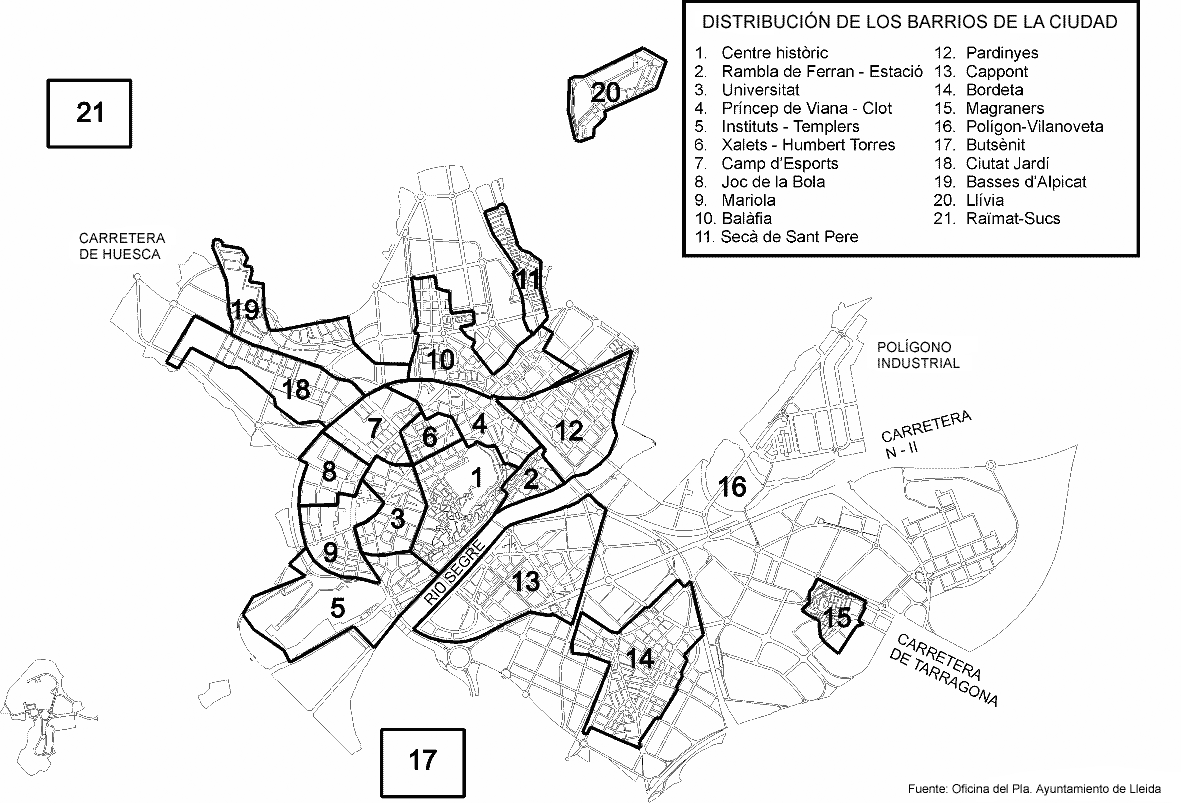
Our LL is located in Lleida at Maragall Street 8, 2003, Lleida within the University area (see figure 2), which is part of District III (see figure 3). This location is a key point for student activity, as it is situated next to the Faculty of Letters of the University of Lleida (UdL) and serves as a vital thoroughfare for the university community.
According to the Statistics Institute of Catalonia (Idescat, 2026), Lleida currently has a population of 147,369, of which 21.57% are foreigners. Idescat estimates that 9,276 people live in the area where our poster is located, of whom 2,874 are immigrants. This small foreign population represents only 8.39% of the total foreign population living in Lleida. These statistics show us that although there are people from other origins in the neighbourhood, there is not a large concentration of them as in other areas of the city. Therefore, the character of the neighbourhood is defined not so much by the origins of its residents as by its transient and variable population. The area sees a large daily influx of young adults, including local and international students and teachers (aged between 18 and 50), whose daily presence shapes the linguistic needs of the area.
In socio-economic terms, the university district is a mixed middle-class area with a high concentration of service sector activities, closely linked to education and public services. The presence of the UdL acts as a major economic driver, fostering a high concentration of service sector businesses, such as student rental accommodation, cafés and leisure establishments. The area is characterised by a high degree of social and cultural mobility, with a property market largely oriented towards young people through the rental sector. The poster’s location near the university entrance is intentional, as it serves as a visual meeting point for music fans in an area which, although neither gentrified nor overrun by tourists, acts as a vibrant cultural hub for the city’s young people.


3. Methodology
To conduct a thorough analysis of our linguistic landscape, we made three visits to the LL in Maragall Street. During the first visit on 20 February, we found a wall covered with posters (see figure 4) and chose the one that said ‘Seek ‘em all’ (see figure 1). Then, on 26 February, we returned to the same place to observe the surroundings (see Figure 5) and take photos of the neighborhood (see figures 6 and 7) to see the different linguistic characteristics of the street. During that session, we noticed that there were more posters on the same street, highlighting the fact that they are placed there because they attract more people who might be interested (detailed below). To conclude the visits, on 6 March, we visited the token for the last time to confirm that it was still there. We observed that there had been no change in the poster or its surroundings.
During our visits, we observed that Maragall Street has a high number of commercial signs and messages. The surroundings of the poster show that it is part of a wall where English is widely used in non-official signs, such as in the following titles: ‘Rock & Grunge 90's Night’, ‘Brian Caffrey Group, The Legend That Never Was Tour’, ‘Emma Casadeví A Tribute To Amy’, and ‘Little Folks Saint Patrick's Day Concert’. Although Catalan and Spanish are the main languages used in the University neighborhood, the high mobility of young people is one of the reasons why English is widely and prominently used to offer a service related to a global pop culture and to attract attention as part of the massive consumption patterns of international music and international celebration event, while Catalan and Spanish are more commonly used to provide additional -yet key- information, such as timetables, place, where to buy tickets, etc.
This token serves as a clear example of bottom-up language policy, representing a non-official sign in an urban area by a private commercial enterprise. As Backhaus (2006) points out, there are two ways to mark territory with two different types of signs. The official top-down laws imposed by the legal framework of La Paeria of the City Council of Lleida (2023) prescribe the use of Catalan along with Spanish, which is official in Spain in Article 14. This also allows for the use of additional languages of the targeted clients, which in our LL would be English. The sign we have chosen overlooks institutional authority and gives priority to ‘commercial multilingualism’ (Cenoz & Gorter, 2009). It also marginalises the historically minority language in Spain, that is Catalan, which is entirely absent from the sign despite its official status and the city’s language regulations. Using English as a global music-consumption identity affiliation and Spanish for more functional details (the date and time ‘Viernes 30 de enero a las 21:30h’, the nature of the performance ‘tributo a Metallica’, the celebration milestone ‘40 aniversario’, and the purchasing information ‘entradas a la venta en entradium.com’), the poster communicates a sense of subversion -underground styles- and solidarity within music culture, and more specifically heavy metal. This bottom-up practice ignores although it does not counteract official linguistic hierarchies to address a specific audience directly.


4. Results and discussion
Landscape values and functions
As mentioned in the Observatory of the Landscape of Catalonia, specifically in the Landscape Glossary (2026), there are six values: aesthetic, identity- related, historical, social, spiritual and productive. However, our LL contains only four of the aforementioned values. This token is characterised by forming part of the various landscape values simultaneously. Specifically the following ones:
Aesthetic values
The visual register commonly connected to heavy metal culture is reflected in the poster's design. Text, images, typography, and color are all semiotic resources that are combined in their visual composition to create meaning. The communication effect of the sign is determined by this multimodal composition. First, the aesthetic combines dark tones and cross-shaped images that are typical of heavy metal designs. The genre's sad and grim atmosphere is intensified by the large number of black and color. The main message, on the other hand, is defined by a white circular shape that boosts the poster's visual impact while offering a strong visual center point and helping the text's comprehension.
Additionally, typography is important too. The poster's Gothic-themed font reminds us of Metallica's famous lyrics. "SEEK 'EM ALL", written in English, visually mirrors the band's famous typographic style. This is a clear example of intertextuality, as the style makes reference as well as visually references the band's original visual style. The phrase is specifically used as a playful parody of the band's first album title, Kill 'Em All.
The poster expresses more than just language with the combination of graphic symbols. Here, English words not just as means of expression but also as an element of the visual identity of global rock culture. For viewers who are aware of the cultural allusion, the combination of typography, color, images, and text increases the sign's emotional connection and visual impact.
Historical value
There is also a historical meaning to this symbol. One of the most influential bands in heavy metal history, metalica commemorates the 40th anniversary of the release of their album Master of Puppets in 1986. The group was founded in 1983 and became a major force in global rock culture with albums like Kill’ em all (1983), Ride of Lightning (1984), and Master of puppets (1986). They also made an important contribution to the development of thrash metal. Over decades, their music and aesthetics have become globally recognized cultural symbols in popular music. Additionally, by mentioning a local event that takes place in Lleida, the poster connects this global musical heritage to a specific urban setting. the token also acts as a visual representation of how elements of worldwide music culture are adapted for local context. Examples like this show how the history of international rock music is clearly incorporated into Lleida’s everyday city setting, where local traditions and references to other cultures coexist.
Identity value
On the other hand, and related to the previous value, this symbol also has an identity function. It facilitates the connection and collaboration of Lleida residents with the international heavy metal community. As mentioned in previous sections, the English language is used symbolically, reinforcing participation and inclusion in this global cultural movement, all related to music and music culture. This demonstrates that the use of English is linked to modernity, cosmopolitanism, and cultural competence (Cenoz & Gorter, 2009).
Productive value
Looking at it from a broader perspective, we can also associate this token with an economic function. This is manifested through the use of the English language, which acts as a "linguistic currency" or sellable product in the market (Niño Murcia, 2003). Essentially, its use is linked to financial value. The fact that the title has not been translated into another language further reinforces the idea of prestige and competition within the market. One could say that English becomes part of the product itself, as its use increases demand, in fact, the group’s name is already actually in English.
Social meaning of the linguistic landscape form and uses and its interplay with Englishization
Despite the fact that Catalan and Spanish are the official languages of the city of Lleida, we can say that their presence in the cultural and commercial sphere is limited. As has been observed in Lleida's linguistic landscape, there are many extensive processes of Anglo-Saxonization concerning the musical mass consumption area. This token is a prime example, as English takes center stage visually. This poster demonstrates how widely local languages interact and intertwine through linguistic structures. Therefore, the use of English in this token is not only informative but also strategic in terms of the market realm and symbolic in terms of global music-based identity displays. Being aware of the local audience and the languages they speak, English is chosen over them due to its prestige and the cultural connections it may have on a global level. ULL: instrumental Spanish with the dates is key: everybody could understand, by denotation and connotation.
All of this reveals three aspects. The first one unpacts the significant impact that media can have worldwide, particularly the digital distribution of music, in this case Metallica. The second one refers to the vast international expansion of cultural markets. And finally the potential connection that a city like Lleida can have with transnational cultural trends.
If we look at less prevalent languages like Catalan, we might conclude that this could be understood as a slight strengthening of linguistic hierarchies worldwide. English is the central language, given its commercial and cultural role. Local languages (Spanish and Catalan) have less visual weight, serving primarily an informational function. This leaves local minority languages (Catalan) in a less privileged position, as their visual role is less prominent, contributing only background information. Only Catalan is invisible and excluded. Spanish is granted a key instrumental function. All of this leads us to believe that linguistic landscapes have the potential to replicate the power relations that generate inequalities between minority and majority languages.
Our perspective on this situation is as follows. On the one hand, we are aware that this linguistic landscape could relegate local languages to a secondary role. However, on the other hand, we believe that it does not violently eliminate local languages, but rather, in a way, could contribute to the neutralization of English, given its role as a language of entertainment and culture. We also believe that this example clearly illustrates the major economic powers and how cultural globalization can alter different language configurations, placing them in different hierarchical positions. In this case, English would occupy the highest position, being a primary attraction at the commercial and community levels. Spanish would occupy a lower position, assuming a function associated with local administration and the community of Lleida. And Catalan would be excluded from the landscape.
5. Concluding thoughts
This project allowed us to address sociolinguistics while working on Lleida's linguistic landscape outside of the classroom. We were able to create connections between what was presented in class and the real world, as Sayer (2009) mentions. As a result, when we studied the Metallica poster and their album "SEEK 'EM ALL," we came to the conclusion that they symbolize the sociolinguistic structure, cultural trends, and economic interests of society.
Moreover, we had the opportunity to see and examine how language is employed in society. We became more aware of the language landscape that surrounds us in our daily lives as a result of what at first seemed to be a usual concert advertisement turning into a good example of the interaction between local and global languages. In this case, Spanish is used to give important information to the local audience, while English becomes a symbol of the musical industry and its global influence.
It is important to remember that after choosing our linguistic landscape, we used different pedagogical methods to carry out this project.These included the blog, empowerment and participation technologies, the interactive map, and the program where we uploaded our LL token (Sabaté-Dalmau, 2022).
In addition to this , we would like to highlight that this project has been quite enjoyable and we have had a great time improving our knowledge. But we also have to admit that there were moments when it was challenging managing the blog, as sometimes we would add information but it wouldn't appear.
To sum up, the project has increased our curiosity in the importance of languages in our society. Furthermore, it has brought emphasis on the importance of spreading knowledge, in this case, to the streets of Lleida. This direct interaction with the discipline of sociolinguistics has been very helpful in order to apply the concepts learnt in class.
6. References
Backhaus, P. (2006). Multilingualism in Tokyo: A Look into the Linguistic Landscape. International Journal of Multilingualism, 3(1), 52–66. https://doi.org/10.1080/14790710608668385
Britannica Editors. (2026, February 6). Metallica | Members, Songs, Albums, & Facts. Encyclopedia Britannica. https://www.britannica.com/topic/Metallica
Cenoz, J., & Gorter, D. (2009). Language Economy and Linguistic Landscape, in E.Shohamy & D.Gorter (Eds.) Linguistic Landscape: Expanding the scenery, (pp. 55-69). New York/London: Routledge.
Google Maps. (2021). Google Maps. Google Maps. https://www.google.com/maps/place/25003+Lleida
History | Metallica.com. (2016). Metallica.com. https://www.metallica.com/history/?srsltid=AfmBOoqMLHS8ITfaeHUETbwJ8NsfAQ_IHh1EsssjcgVVT1qEASOVsebo
Idescat. El municipi en xifres. (2026, 3 febrero). https://www.idescat.cat/emex/?id=251207
Idescat. Població estrangera a 1 de gener. Per districtes. Lleida. (2026, February 25). Idescat.cat. https://www.idescat.cat/poblacioestrangera/?b=10&geo=mun:251207
Marc legal. (2023). La Paeria - Ajuntament de Lleida. https://www.paeria.cat/ca/serveis/llengua-catalana/per-que-cal-aprendre-catala-i-utilitzar-lo/marc-legal
Mooney, A. & Evans, B. (2015). Chapter 5. Linguistic Landscapes. In: Language, society and Power. London & New York: Routledge. 86-107.
Niño-Murcia, M. 2003."English Is Like the Dollar": Hard Currency Ideology and the Status of English in Peru. World Englishes, v22 n2 p121-42 May 2003
Peñaranda, A. (2022). Diseño gráfico, tipografía y música. REVISTA IMAGO, 6. https://doi.org/10.56908/imago.n6.304
Röhm, S. (2025, February 6). The art of band logos in heavy metal: a symbol of identity and power. GraveArt NEU. https://www.graveart.de/post/the-art-of-band-logos-in-heavy-metal-a-symbol-of-identity-and-power
Sabaté-Dalmau, M. (2022b). ‘Localizing English in town’: a linguistic landscape project for a Critical Linguistics Education on multilingualism. International Journal Of Bilingual Education And Bilingualism, 25(10), 3580-3596. https://doi.org/10.1080/13670050.2022.2067978
Sayer, P. (2009). Using the linguistic landscape as a pedagogical resource. ELT Journal, 64(2), 143-154. https://doi.org/10.1093/elt/ccp051
Singer, Q. T. (2024, July 20). Every Metallica Album In Order Of Release. Forbes. https://www.forbes.com/sites/entertainment/article/metallica-albums/
(2026). Stesa.com. https://stesa.com/images/0X0/2011-04-14-13453/Barrios_de_la_ciudad_de_Lerida.gif
The Landscape Observatory of Catalonia. (2026). Glossari de paisatge/ https://www.catpaisatge.net/en/landscape-resources/landscape-glossary
Westphal, M., & Jansen, L. (2021). English in global pop music. Bloomsbury World Englishes, 1, 190-206).


This blog analyzes a bottom-up poster in Lleida, Spain, used for commercial purpose. The poster promotes a metal concert. The poster is valid for the Linguistic Landscape project, because it combines English and Spanish. The authors found that English occupies the main position on this poster, despite it not being the official, nor used language in this area. English is used to catch attention, then Spanish is used to give practical information (like the date and time). That is an example of globalization in the city and the poster’ and its author’s international identity.
ReplyDeleteI noticed the authors talking about English on the poster as a “linguistic currency” but also to express the identity value, which I found very interesting. I appreciated the background about metal music and the music band, as if gave me a better picture about the whole context of the poster and made this blog even more entertaining to read.
I would enjoy a comment on why the authors think Catalan is not used on the poster, but I understand that this project is focused on English, so even without this the blog seems very comprehensive and clear.